Results & Reporting · 2 MIN READ
How to Read a Peptide Certificate of Analysis
Most people look for one number on a COA. Here is what else is on ours, and what each part tells you.
Yuri Parounakian · 8 Aug 2026
Most people open a COA and look for one thing: the purity percentage. That is a good start, not the whole story. This is how to read ours, from top to bottom.

Which vial is this about?
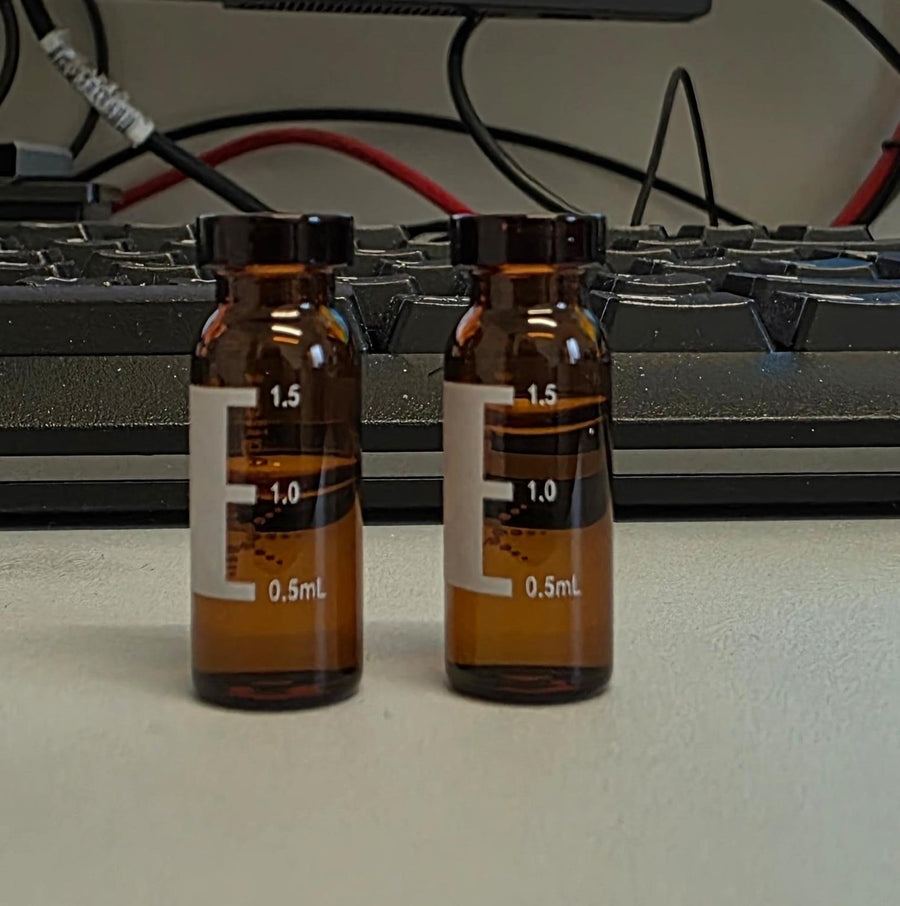
At the top: the COA number, the compound as declared by you, the amount on the label and the date. The photo is of your vial as it arrived at our lab. A result applies to that vial only, not to the rest of the batch.
Purity
The share of the UV signal at 214 nm that comes from the main compound, with two decimals. Below it: every other peak from 0.10 %, with its retention time. Smaller peaks are not listed one by one, but they count towards purity: the report shows them as one sum, and Total impurities is 100 % minus the purity.
Identity
If you ordered Identity & Content, you see the measured mass next to the expected mass, and the retention time next to that of our reference standard. Identity is confirmed only when both match.
Content
The amount of compound in your vial, in mg, measured against a calibration with a reference standard. Compare it with the amount on the label at the top of the report: that comparison is often the reason to test.
The evidence behind each result
You do not have to take the numbers on page 1 on trust. Page 2 shows how purity was measured: the chromatogram at 214 nm, with a close-up of the main peak. If you ordered Identity & Content, page 3 adds the mass spectrum and the calibration line that the content is calculated from.

What was not tested
A COA only covers what is on it. Ours does not say anything about sterility, endotoxins, solvents or heavy metals, and never anything about use or dosing. If a test is not listed, do not assume it was done.
Is it genuine?
Every Nexora COA has a number and a private verification code. Scan the QR code, or enter both on Verify COA, and you see whether the certificate is valid, superseded or revoked. Anyone you share the certificate with can check it the same way.
Want to see your own? Test a sample.