Analytical Methods · 3 MIN READ
Inside the Mass Spectrometer: From Droplet to Mass
A spray, a vacuum and four metal rods. How we weigh a molecule that is far too small for any balance.
Yuri Parounakian · 8 Nov 2026
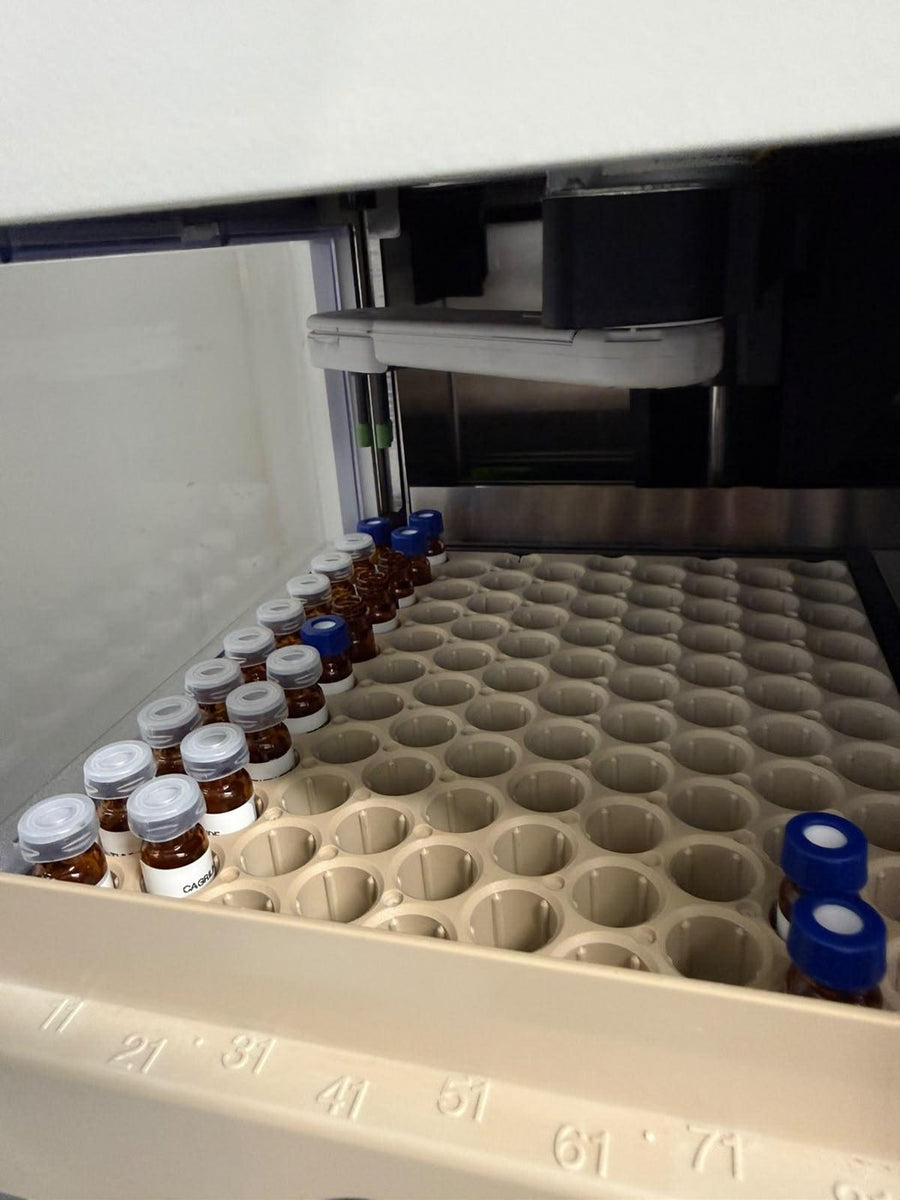
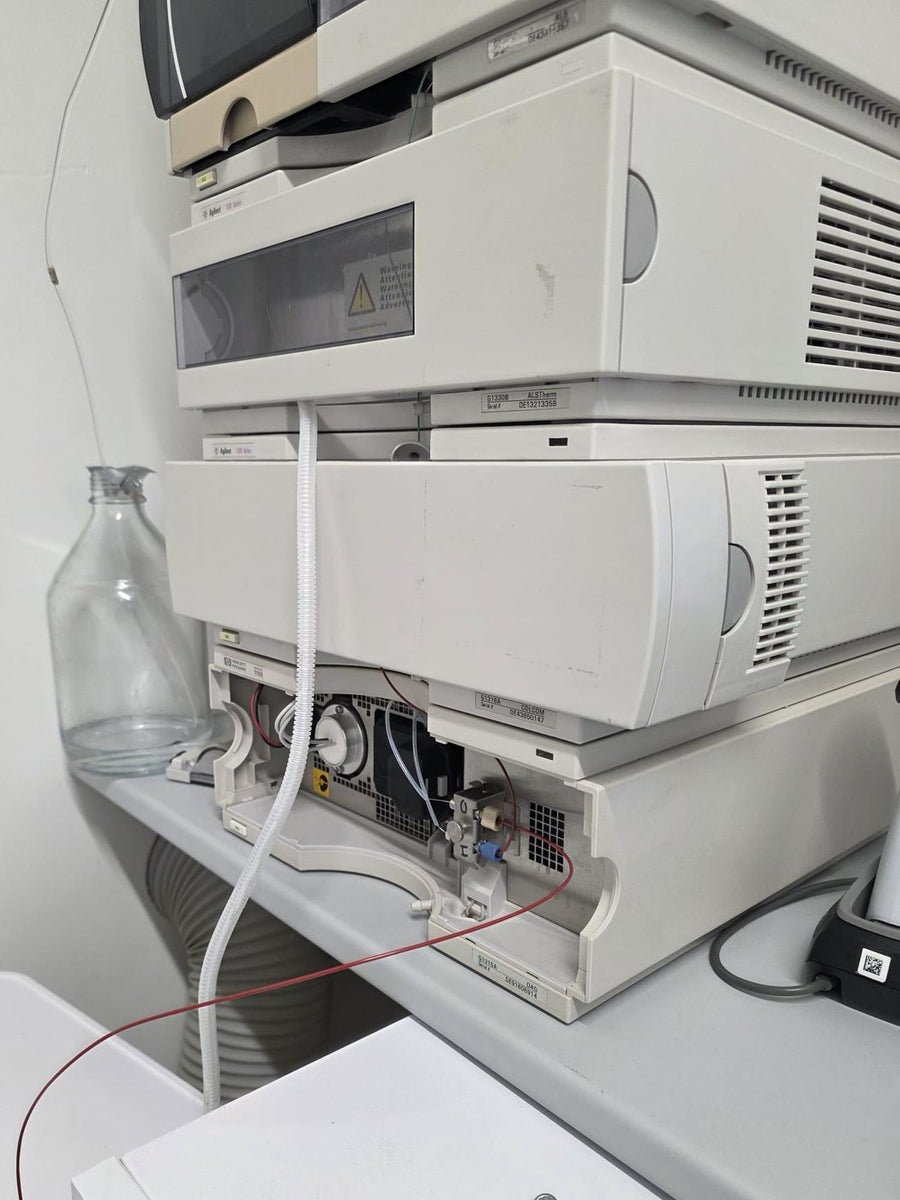
Our lab balance weighs to a hundredth of a milligram. A single peptide molecule is about a million billion times lighter than that. We still weigh it, with a mass spectrometer. Ours is an Agilent 6130, coupled to the HPLC: that is the LC in LC–MS. It weighs what comes off the column, peak by peak.
From liquid to ions
A mass spectrometer can only weigh molecules that carry a charge and fly through a vacuum. So the liquid from the column is first sprayed from a fine needle into a strong electric field, typically a few thousand volts. It leaves as a fine mist of charged droplets: electrospray. Hot nitrogen, often a few hundred degrees, dries the droplets. As they shrink, the peptides are left behind with extra protons attached. Now they are ions, ready to fly.
Four rods and an electric field
The ions are drawn into a vacuum, towards four parallel metal rods: the quadrupole. The electric field between the rods lets through only ions with one particular mass-to-charge ratio; all others swerve off. By sweeping that field across the range, again and again, the instrument scans from light to heavy and counts the ions that reach the detector. The result is a mass spectrum.
Why one peptide shows up several times
The instrument does not measure mass directly. It measures mass divided by charge, written m/z. A peptide carrying four extra protons appears at about a quarter of its mass; with five, at a fifth. A peptide of 4,000 Da with four protons, for example, shows up at about m/z 1,001. Larger peptides pick up different numbers of protons at the same time, so one compound shows up as a row of peaks. TB-500 appears at 4+, 5+, 6+ and 7+: around m/z 1,242, 994, 828 and 710.

One mass from a row of peaks
Every peak in that row points to the same molecule. From the whole row we calculate one mass, about 4,963 Da for TB-500, and it must match the expected mass within a fixed tolerance. HGH, a protein of 191 amino acids, makes a ladder of more than a dozen charge states. Together they still give one mass: about 22,125 Da.

What a mass can tell, and what not
A matching mass says the expected molecule is there. It can also reveal a changed form: an extra 16 Da often points to an oxidised building block.
But mass has a blind spot. Some building blocks exist in two mirror-image forms that weigh exactly the same; ipamorelin contains two of them. That is why we confirm identity only when the mass and the retention time both match our reference standard. More in Why HPLC Alone Cannot Confirm Compound Identity.
What it does not measure
The mass spectrometer tells us what is there, not how clean the sample is or how much is in the vial. Purity comes from the UV signal at 214 nm (How an HPLC Separates a Peptide). Content comes from a calibration with a reference standard. Identity is part of Identity & Content.